
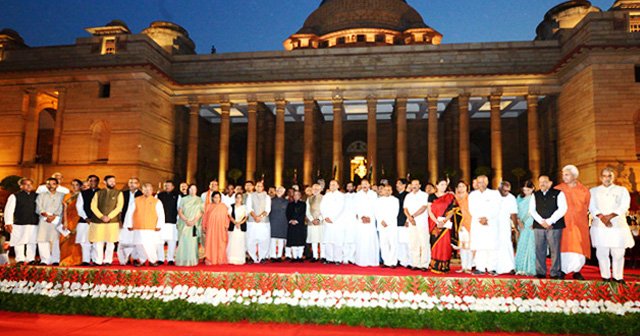
According to the Constitution of India, in the everyday administration, the Prime Minister is assisted by the Council of Ministers, which consists of the Cabinet Ministers, Deputy Ministers, Ministers of State with independent charge, Ministers of State working with the Cabinet Ministers and others. The Prime Minister is the Chairperson of the Cabinet. The core Council of Ministers is called the Cabinet, ministers of which are decided by the PM. The various departments are allotted to various ministers by the PM. The PM presides over Cabinet meetings and oversees the important functions of the Cabinet. Ministers are removed from departments if the PM does not approve of the performance of the minister.
Cabinet Ministers and Prime Minister
The Prime Minister of India is the Head of the Union Government. Unlike the President who is the Head of the State, the PM is the Chief of government at the Centre In other words, he is the real head of the executive branch of the Union Government. He is the Leader of the House of Parliament to which he belongs.
As India follows the Westminster Model of constitutional democracy, it is the Prime Minister who oversees the day-to-day functioning of the Indian administration. He is also the Chief adviser to the President. The PM has many functions and powers. The PM holds the power to form his/her Council of Ministers, choosing members of his/her party for particular ministries within the working of the country.
The PM also oversees defense-related issues of the country. He makes all important policies and schemes of the government. He has to devote attention to all judicial appointments, appointments to State Administrative Tribunals, Central Administrative Tribunal, UPSC, Election Commission. The PM is solely in-charge of certain departments or ministries like Ministry of Planning, Department of Atomic Energy, Department of Space and Ministry of Personnel, Public Grievances and Pensions.
Categories of Ministers in Government
There are three categories of ministers within the Council of Ministers – Cabinet, Ministers of State with independent charges and Ministers of State working with the Cabinet Ministers.
Roles and Responsibilities of Cabinet Ministers of India
The Cabinet of India is the core of the Council of Ministers of the Union Government, and the collective decision-making body. All the important portfolios of the Central Government together comprise the Cabinet. Some of the most important ministries are Ministry of Home Affairs, Ministry of External Affairs, Ministry of Defence, Ministry of Finance, Ministry of Commerce and Industry and others.
The role of the Cabinet ranges from advising the Council of Ministers and provide assistance to them, attend Cabinet meetings called by either the Prime Minister or any one of the Cabinet ministers to discuss issues related to his ministry. More importantly, it is the role of the Cabinet primarily to keep the confidence of the Houses of Parliament during the party’s tenure in the Union government. It is the collective responsibility of the Cabinet to be accountable to the two Houses of Parliament, for its policies and schemes.
Roles and Responsibilities of Ministers of State with independent charges
The Ministers of State with independent charges are the second category of ministers in the Council of Ministers. They are not as important in their role as the Cabinet. There is no overseeing Cabinet Minister for the portfolio of the Minister of state with independent charges.
Roles and Responsibilities of Ministers of State
Ministers of State working with the Cabinet Ministers are the third rank of ministers. These are junior ministers who assist the Cabinet Minister in the particular portfolio. These junior ministers look after one or two aspects of the Cabinet portfolio, and not the whole ministry as such