
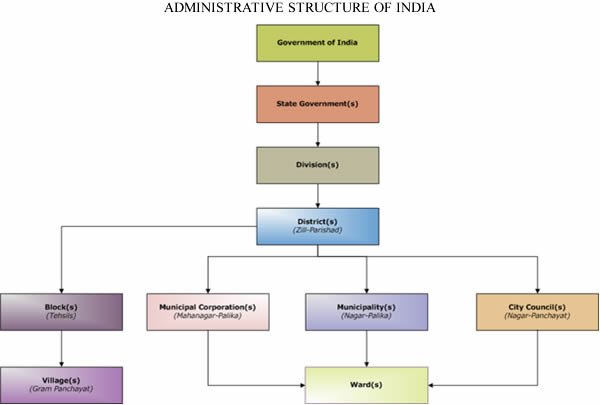
Indian structure of government can be classified primarily into three subgroups i.e. first, Government of India or Central Government or Union Government. Secondly, the State Government and thirdly, the Union Territories.
In India, there are also local government bodies such as Village (rural) Administration and Urban Administration.
To summarize,
India’s Administrative Divisions refer to the smaller administrative units, comprised of various subdivisions. There are 29 states and six Union Territories in addition to the one National Capital Territory so, in all, there are seven Union Territories. The smaller local government units are governed by State Statutes and the Union Territories are subject to the Union Parliament.
In rural areas, the smaller subdivisions are called villages and blocks. In large urban areas, these are replaced by Urban Local Bodies. Sub-Districts, or Tehsils, refer to several villages in one cluster while Hobli refers to only a few villages in a group. There are over 250 000 villages in India.
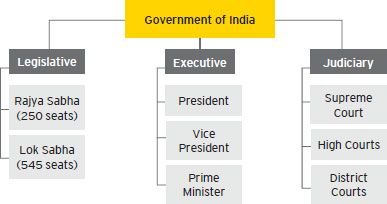
Structure of Government of India
The Government in India or the central or the union government is divided into three main sections namely the executive, legislature and the judiciary. The image is shown below which explains the structure and the duties of each.

Structure of State Government of India
The state legislature or the state assembly in India is headed by the chief minister of that state. The state legislature is divided into two parts namely the Vidhan Sabha and the Vidhan Parishad. The governor for the state is elected by the prime minister himself.

Structure of Union Territories Administration in India
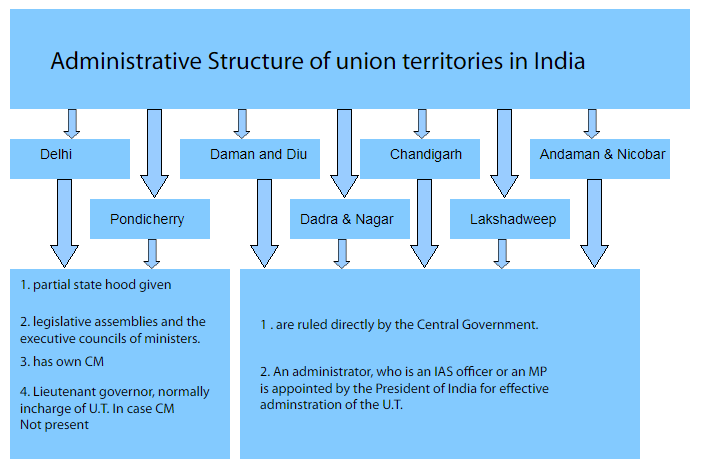
There are a total of 7 union territories in India namely Delhi, Pondicherry, Daman and Diu, Dadra & Nagar, Chandigarh, Lakshadweep, and Andaman & Nicobar Islands. The administrative structure of Delhi, Pondicherry is quite different from those of the rest of the union territories.
Below image explains the administration and difference between both types of UT.
Structure of Local Government Bodies in India
Village (rural) Administration:
Panchayati Raj: Basic unit of Administration in India, comprising of three levels –
1. Gram (Village) – Gram Panchayat (for one or more than one village)
2. Taluka/Tehsil (Block) – Panchayat Samiti
3. Zila (District) – Zila Panchayat
Gram Panchayat elects one Sarpanch and other members.
Powers and responsibilities of Gram Panchayat:
1. To help implementation of the development programmes and schemes of the Panchayat.
2. To identify beneficiaries for different programmes and schemes. However, if the Gram Sabha fails to identify such beneficiaries within a reasonable time, the Gram Panchayat shall identify the beneficiaries
3. To solicit support in cash or kind or both and voluntary labor from the public for community welfare programmes
4. To support the programmes of mass education and family welfare.
5. To promote unity and harmony among all sections of the society in the village.
6. To seek clarification from the Mukhiya, Up-Mukhiya and other members of the Gram Panchayat about any particular activity, scheme, income, and expenditure.
7. To discuss and recommend appropriate action with regard to reports of the Vigilance Committee.
8. To consider levy of taxes, rates, rents & fees & enhancement of rates thereof.
9. To consider all such matters as may be referred by the Gram Panchayat for its decision.
Block Panchayat/Panchayat Samiti comprised of all sarpanches of the Panchayat Samiti area, the MPs and MLAs of the area, the SDO of the subdivision and some other members from the weaker section of society. Block Panchayat/Panchayat Samiti works for the villages of the tehsil or taluka that together are called a Development Block.
Zila Panchayat Chief of administration is an IAS officer and other members are elected by the Gram Panchayats and Panchayat Samitis.
City (Urban) Administration
Mahanagar Nigam (Municipal Corporation ): In Metro cities. At present around 88 Nagar Nigam are in operation. From every ward, there is a Sabhashad, elected by the voters, whereas one Mayor elected separately.
Nagar Palika (Municipality) : Cities having more than 1,00,000 population (there are exceptions as the earlier threshold was 20,000, so all those who have a Nagar Palika earlier, sustains it even though their population is below 1,00,000). From every ward, a member is elected whereas the Chairman is elected separately.
Nagar Panchayat/Nagar Parishad (Notified Area Council/City Council):
Population more than 11,000 but less than 25,000.
1. Water supply for domestic, industrial and commercial purposes.
2. Public health, sanitation conservancy and solid waste management.
3. Fire services.
4. Urban forestry, protection of the environment and promotion of ecological aspects.
5. Slum improvement and up gradation.
6. Urban poverty alleviation.
7. Provision of urban amenities and facilities such as parks, gardens, playgrounds.
8. Burials and burial grounds; cremations, cremation grounds and electric crematoriums.
9. Cattle pounds; prevention of cruelty to animals.
10.Vital statistics including registration of births and deaths.
11.Public amenities including street lighting, parking lots, bus stops and public conveniences.
12.Regulation of slaughter houses and tanneries.